Mark Hamill as the Joker for the Dark Knight Sequel

No, that is not a breaking news item. It is a call to action. Here is how I see it, without Heath Ledger, there is only one person who can play the Joker well enough. Mark Hamill has done the voice of the Joker for over a decade, and once you hear him, you know he is The Joker. He did the voice in the animated series and stole the show in the recent hit video game Batman: Arkham Asylum.

His long time co-star in the voice booth, Kevin Conroy, was asked once about how Mark Hamill can do that voice. He said that Hamill goes to another place, that he becomes the Joker. As far as live action acting, don't forget that Hamill rocked Broadway in the lead role of Mozart in Amadeus in the 1980s, and was deliciously evil in Jay and Silent Bob Strike Back. And, it's been 30 years since he was Luke Skywalker: with some green hair and that voice, no one will think Jedi.

Here's how the Dark Knight sequel with Mark Hamill would work:

Batman is forced underground, as hinted at the end of Dark Knight. Like in Dark Knight, the original Joker has spawned copycats, and Batman can't keep up with them all with the Gotham PD after him. The Gotham PD detective chasing him is named Edward Nigma. He is incredibly smart, a clean cut boy scout, loves puzzles and discovering who Batman's identity is the greatest puzzle he has ever had.

Nigma infiltrates a Joker gang to see how Batman operates. The new Joker discovers that he is a cop and laughs at Nigma's quixotic quest. "Who cares who Batsy was?" The Joker says. "You'll take all the fun out of it. Just. Like. A. Cop." The Joker shoots Nigma in the knee and leaves him behind to slow down Batman during a chase. Nigma has to leave the PD and all he is left with a limp, a pension and a burning anger to unmask the Dark Knight.

He becomes the Riddler to draw Batman away from Joker by committing outsize crimes that strike closer and closer to Bruce Wayne as the Riddler pieces together the Dark Knight's identity. The Riddler is playing with Batman, trying to see what resources and skills Batman has.

As Wayne Manor is rebuilt, Bruce has to decide if his life as Bruce is expendable. The Riddler is getting closer, and if Bruce Wayne is exposed, Batman will cease to exist. "Batman was meant to strike fear into criminals. Now it seems only to inspire them, to challenge them. Maybe a regular guy like Jim Gordon is the best answer to crime. Show the criminals a decent cop, with a family, who's not perfect instead of a rich boy parading around as a bat," Bruce says to Alfred in one dark moment.

The Joker just wants to torture Batman and Gotham for giggles; he doesn't care who Batman is. Except that he realizes that the Riddler is on to something: the greatest torture of Batsy would be to reveal his identity to the city. He captures Batman, peeks under the mask, laughs maniacally, and sets him free. Now that he knows the secret, and Riddler doesn't, he's going to torture Riddler as well. And Batman can't come after him or the secret will be get out. Joker has free reign and the only way Batman can keep the secret is to kill him.

Joker teases the Riddler mercilessly, until Riddler falls for a trap that Batman has laid and finds Joker and proof that the Joker is Batman. Riddler kills Joker, which the Joker finds hilarious, knowing the true secret will die with him. Batman captures Riddler and sends him off to Arkham.

This is just a rough sketch, it's missing an overarching theme (other than being a masked hero eventually backfires), and I have no idea who would play Riddler, but Chris Nolan is welcome to have the idea.


My Mass Effect Rant

Mass Effect is a sci-fi role-playing video game that was released in 2008. I played the PC version, which scored an 89/100 on Metacritic. The game has been lauded for its innovative dialog system, its engaging story and its roleplaying potential. The sequel was just released and has been received by the video gaming public with a huge amount of enthusiasm.

I thought it sucked. Horribly.

Sucky point #1: elevators. There are a lot of them, and they take forever. There's even a damn elevator inside your own starship, and it has less than 5 decks! Some of these elevator rides are at least 15-30 seconds long. And during the whole ride you get to do nothing but watch the back of your character's head. Exciting, no? This is bad design, and, frankly, disrespectful of a player's time. Did Otis Elevator provide funding for this game's development?

Sucky point #2: talking. Bioware is known for shaping a character's personality and the storyline via how the player has them interact with others. They did this to great effect in Star Wars: Knights of the Old Republic. In Mass Effect, it feels like half the game is talking to non-player characters with little effect. But the dialogue choices don't reflect what is actually said (somehow this is an improvement?). Eventually, I turned on the subtitles and space-barred through the text. So much for all of that voice acting. Doing so meant that I ended up choosing some dialogue choices randomly, to no apparent difference in any outcome. Did AT&T provide funding for this game's development?

Sucky point #3: story. A soldier is the chosen one to save the galaxy from omnipotent Reapers that wipe out all organic life in the galaxy on a regular basis. Why do they do this every million years or so? They are too alien for us to understand - a writer's cop out, especially in a game filled with aliens. Weak. Even worse was that many of the side quests involved idiotic errands, like telling alien B that alien A like-liked them. Did Clorox provide funding for this game's development?

Sucky point #4: graphics. My 6 year old son wanted to know why my character had a big scar running along his jawline. I pointed out that all of the characters had that same scar, among many others. Oh, and the disappearing terrain tiles on planet was a lot of fun. I remember playing crappy games in the 90s with better graphics, better character animation but a lot less acclaim than this one. Did a plastic surgeon provide funding for this game's development?

Sucky point #5: gameplay. Combat was irritating, level design was boring, controls were rough and it. crashed. a. lot. during. fast. moving. action. sequences. The vehicle controls were deplorable. The inventory system was amateurish. And supposedly there were 'biotic' and 'technological' weapons, but I never noticed these and everything was a gun battle on rails. I don't think anyone would have provided funding to accomplish this.

Yes, a pretty harsh review. Clearly, I don't get what all of the excitement is about. And I could be wrong - most gamers seemed to worship at the feet of this game.

Five new lessons learned about tying shoes

The truth is that even this most basic of life skills can be improved in its teaching and executing, and you have to be open to these things even after thirty years of doing it the old and inefficient way.

I had one hell of a time learning how to do tie my shoes when I was five. My father even took an old Florsheim dress shoe and painted each part a bright color to teach the vocabulary of the shoe (tongue, sole, heel) because I was not getting any of it. The shoe was awesome: more colorful than a clown shoe and utterly ridiculous because it was a dress shoe.

But it didn't matter: I just could not get the knot right long after my younger brother aced it. My sister, who was about 1 at the time, learned before me, according to the ever more exaggerated family myths. Like many of my troubles as a kid, the parents chalked this up to being my fault (lazy, uncooperative, etc.) rather than something beyond my control. My parents were pissed and I felt like a worthless idiot.

It turns out that there are at least 17 different ways to tie your shoes. I found this site by googling 'tying a shoe' and choosing the first site it returned. Lesson #1: check the internet on how to improve on the most mundane tasks. It will prevent you from stumbling along in frustration due to incomplete information and outdated methods. And frustrating others trying to learn your ancient ways. Unfortunately, I learned this only when writing this blog post.

It turns out that many of us have been working with a substandard shoelace knot, at least for beginners. There are two stages to tying the knot: the starting knot and the loop knot. With the standard starting knot, you have to plant a finger on the knot to hold it tight while you do the loop knot. Lesson #2: use a double starting knot instead. You will have both hands free to tie and twist the loops. Go ahead, try it.

It worked, huh? My wife learned this from a coworker whose child was taught this in preschool years ago. Lesson #3: talk to others. Like many innovations, this is simple, effective, but does not appear to have spread very far, in part because who shares shoe-tying information? It happened only because my wife brought it up when discussing the travails of teaching my son to tie his shoes. Even still, I don't expect many to try this, because tying shoes is an everyday task, and people are used to the inefficient method, some will no doubt consider this weird.

Speaking of weird, when I was trying to teach my son, my wife watched closely and pronounced that I was doing it wrong - something about which loop was first, or which way to circle the loop. We realized that righties and lefties do the loop knot differently. Which would make it very difficult for a lefty to teach a righty or vice versa. My father and my son are both righties, and I am a lefty. Lesson #4: find the right teacher.

Lesson #5: Subtle structural issues are often the culprit for what are mistaken as a child's behavior problem. In my case, it was being left-handed. This same lesson went unlearned in many other episodes with me.

The New York Times is not worth paying for

The journalism industry is grinding its way through a nasty transition, mostly because the revenue side has fallen apart. Newspapers traditionally have made their money off of ads, with the reader subscriptions often just to support delivery services or as a minimal revenue source. (This is how 'free' print newspapers and broadcast TV can be 'free': they are so chock full of paid ads.)

But the ads have disappeared as advertisers have moved to radio, TV, the internet and even video games. The internet has made newspapers as a delivery channel exceedingly inferior. The only way for them to survive is as websites. But the ad revenue on websites has taken a huge hit because of the recession and because advertisers are figuring out that ads are easy to ignore on the web.

To save itself financially, the New York Times will charge readers for access to its content. It did this with disastrous results half a decade ago, but again, it feels like it has no choice. Back then, I was one of those who paid for TimeSelect. But the times have changed.

First, there are plenty of other free news sources that seemed to have found a working business model: Huffington Post and Politico come to mind. I think it is because they don't have the expenses of a local newspaper (local, state, regional, etc.). In the global environment for global news, the NYT just doesn't compare to free sources, RSS feeds, etc.

Second, the quality of news has sunk to a point where it is not worth paying for. Journalists have an exceedingly high opinion of themselves that is not based on how well they do their jobs, but simply based on their role in society as 'the press.' This has clearly been the case at the New York Times, with its deplorable reporting about WMD in Iraq, it's phoned in, stenographic political reporting, etc. Money is not draining out of journalism solely because of the internet, but because of low quality.

Yes, if this sounds a bit like the hubris of bankers who expect to be paid because they are bankers, not because they are good at what they do, bingo. The difference is that bankers, so far, have an excellent business model. Oh, and the bankers don't get any of my money either, except for the one bank that bought my mortgage, which I had no choice over.

What should the Times do instead, you ask, you snarky reader? Half the Op-ed columnists are big enough properties in their own right that they could make it as media properties, with speaking fees and book royalties allowing them to 'blog' to readers for free. Tom Friedman, Nick Kristof, Paul Krugman and David Brooks would probably be fine. Frank Rich, Gail Collins, Ross Douhat, Bob Hebert and Maureen Dowd probably don't have the media presence to pull it off. As for the NYT itself, well, like GM, it is probably headed for a slow death regardless of what it does. And it will do so without my financial support.

It's not about connecting dots, it's about management and leadership

It's become apparent that the media has jumped all over this 'spy agencies didn't connect the dots' meme about the Xmas Detroit flight bomber. They act shocked, shocked that this has happened. Wasn't this the whole problem with 9/11 that was fixed with the new security procedures, etc.?

No, actually the unconnected dots story is old and seems immune to modern attempts to correct it. And it is not just a national security story. And it is not about connecting the dots. The truth is that this is a failure of management and leadership, not analysis and data collection. See if you analysts out there can figure out the pattern here:

1986: The space shuttle Challenger explodes supposedly because no one connected the dots on the O-ring and freezing temperatures. NASA's investigation actually points the blame finger at how decisions are made and problems with management sacrificing safety for keeping to the launch schedule.

1999: The dot-com bubble causes the stock market to skyrocket and then tank despite data showing irrational exuberance. People lament the lack of connecting the dots by the Fed, but the problem was that Greenspan didn't take action by raising interest rates and call for more regulation in lending.

2001: 9/11 happens because no one connected the dots on al Qaeda plots. The country solemnly concludes that it wasn't a problem in collecting the information, or analyzing it, but on acting on it. Ditto for Enron, MCI, etc.

2003: The shuttle Columbia explodes because no one 'connected the dots' on damage to the heat shield. But, hint hint, the investigation concludes that management failed to act, not that the analysis was lacking.

2003: We go to war in Iraq looking for weapons of mass destruction, even though all of the reliable analysis points to there being none. Attempts to blame the analysis fall on deaf ears when it becomes clear that management dismissed the analysis before it was even started.

2008: The housing market bubble pops, taking the stock market bubble down with it. If only the Fed, Fannie Mae and Freddie Mac and the rest of the government connected the dots, right? It turns out that all of the data was collected, the analysis was done, but that decision-makers and action takers chose to ignore it because they wanted to let the good times roll.

Spring 2009: Mexican authorities repeatedly and desperately alert the World Health Organization about an outbreak of a new flu. WHO drops the ball and does not follow its own procedures for dealing with it, and the delay in their response allows a global pandemic to spring forth, killing thousands.

Xmas 2009: An almost plane bombing happens not because the analysis was not done, but because at each step, the decision makers did not act when their own procedures told them to, starting from our embassy in Nigeria, to the NSA intel guys who knew about Nigerian terrorists training in Yemen, to the DHS people who are supposed to flag people who pay for one-way tickets with cash and don't check luggage. Any one of these pieces of intel was enough to blow the whistle, revoke the visa, do the extra search, etc. and block the guy from boarding the plane. But no one pulled the trigger. Why? They didn't think their piece of information was serious enough or sufficient even though all known procedures and common sense says it was. That is a decision-making failure, not an analytical one. And it happened about a half dozen times in this one case alone.

Why does this keep happening? The answer is pretty straightforward, if you connect the dots.

A) Collecting data is much easier than analyzing it. We are really good at collecting data.

B) Analysis is not all that hard either. In all of these cases, the analysis was done and the conclusions were straightforward enough that a kid in elementary school would know what to take away. (Heat shield probably busted: don't reenter atmosphere!) But the analysis (and analysts) are easy scapegoats for the real problem, which is that...

C) The authorities dismiss the analysis because they don't wanna do what it calls them to do. Acting on the analysis requires decision-makers who are conditioned/trained/promoted to move incrementally, cautiously and with consensus to do something drastic, do it quickly and piss a lot of people off. It's just more convenient for them to dismiss the analysis and justify their dismissal under the guise of prudence, pragmatism, etc. And as a result, the disaster happens.

Solution: we need decision-makers who will act when needed, who don't pass the buck or shy away from their responsibility. There is no procedural reform, no mild incentive changes or organizational reshuffling that will make it happen. This is where the nitty gritty of leadership comes in. Executives need a line of Captain Kirks, David Farraguts and George S. Pattons who will act swiftly and they need to support them so they can carry out their whistle-blowing capability. Lives are on the line.

For you, dear reader, a bonus example where you get to play the manager, with your own money:

2010: the stock market is likely overvalued. Here's some analysis in the NYT that is the equivalent of announcing that a 20% downturn is due, according to PE ratios. You now have the data and the analysis. What will you do? If the analysis is right (and I am not saying that it is) and you take that 20% hit in your stocks' value, then you have little to complain about when others take the same cautious route.

Happy No EOY Recap Here

If you were looking for an end-of-2009 recap, here it is. "2009: 365 days of the world being better than it was in 2008."

There will be no recap of this blog's 2009 posts or to recap what has happened to me personally in 2009. The truth is that doing those things smacks of being egregiously self-centered and self-absorbed. Plus, I don't see any demand for it from my 1.5 readers.

Go spend your internutz minutes on something more useful.

The truth about airline security

Lots of people, especially frequent fliers, are upset about the new flight restrictions in the wake of the almost bombing of that Xmas day flight to Detroit.

Yes, the restrictions seem unrelated to the particulars of the incident (restricting carry-on baggage, when the bomb was in the guy's underwear?). Most restrictions have a low probability of doing anything other than making any attempt so cumulatively difficult that terrorists give up. So TSA throws a bunch of smelly crap deterrents at the wall and hope enough sticks that the terrorists stumble away from the stench. Obviously, this is not working well, and I bet it is backfiring. I suspect we are giving the engineers and scientists, who seem to make up 90% of the terrorists, fascinating security-beating puzzles to solve. Wonderful.

Yes, some of these restrictions are probably driven by the airline industry with little actual connection to security. We have a carry-on epidemic in this country, and telling you that 'security' is the reason why you can't bring a metric shit ton of personal belongings into the cabin is probably the only way to handle it. For security reasons, check your bag, or better yet, FedEx your personal baggage train to your destination ahead of time. The plane, see, is a passenger plane, not a flying storage shed.

Yes, airline passengers will be punished for the gaps in the no-fly list and the lack of scanning equipment at airports. Because those gaps are considered a given and serious attempts to close them were abandoned long ago due to cost or other reasons. TSA is operating under the assumption that terrorists will board planes, so they figure the best they can do is to make sure the terrorists can't destroy the planes they board.

Yes, there are security people who thrive on laying down more restrictions. TSA probably has groups of restrictions that get activated based on the incident. This latest round is what we get for a near miss: for a hit, they would probably ban all carry-on luggage and make passengers wear nothing but hospital gowns. And security people who dream this stuff up probably think the notion of balancing freedom and security is some kind of sick joke. It's all security concerns all the time with them. That's how security people are: that's their job.

Yes, the terror attempts are becoming increasingly inept. Three fourths of the 2001 simultaneous hijackings worked, but the whole concept was a one-shot deal. The shoe bombing failed. Now the 'pants on fire' approach has also failed. The Acme Corp. rectally-stored dynamite stick can't be too far off in our collective future.

Yes, it would be much better for everyone involved (other than terrorists) if the security people took a smarter approach to security. Like maybe putting the burden of proof on passengers, like is done for renting a car, buying a gun, getting a mortgage (post 2007) or obtaining a passport. Give everyone a safety score, like a credit score, and have security requirements scale inversely with the score. Airline travel is a privilege, not a right. Don't like that idea? Well, there's tons of others that are similarly outside of the box we are currently in. Like wearing airline-provided flight suits, for an extra charge, and in exchange skipping the metal detector. It will feel like being an astronaut: a new, fun airline experience!

Yes, those of us who don't fly often are snickering at your outrage. Some of you folks fly too damn much; something like 50% of all domestic flights are for less than 500 miles, a flight of little over an hour. Take a train, use a phone, drive a car, send an email. We should ban flights that aren't long enough for drink service. The helicopter and railroad industries probably need the boost.

What would you like to do instead? Because I think that a lot of the bellyaching about the new restrictions is coming from the same folks who want the TSA to go to any length to keep them safe, so long as they are not trying to catch a flight themselves. The truth is that you can't have it both ways, even if TSA was pumping out the most brilliant security procedures ever.

The Rewrite of the Jedi

There is a part of Return of the Jedi that bugs me. No, it's not the Ewoks. There is one part in the final act, the most important act of the entire trilogy, that is just flat out wrong. You ever watch, read or hear a story and realize that it has completely gone off the rails? Jumping the shark is just a subset of this phenomenon.

My problem is with the final confrontation in the Death Star when Vader suggests that Leia may turn to the Dark Side if Luke doesn't, and in response, Luke yells 'Never!' The setup for this wrong moment is Vader and Luke have already tried to turn one another unsuccessfully on Endor. Luke attacked the Emperor, Vader intercedes, they battle. Luke hides and Vader goads him to fight by realizing that Luke is protective of Leia. He realizes he's hit a soft spot and uses it to anger Luke to the point of attacking him.

1st moment that plays wrong: Vader uses knowledge of Leia to goad Luke, nothing more. Think about this: Vader just learned that Luke has a sister, meaning he has a daughter, Leia Organa. Vader is calm, using the Force, able to think clearly. A daughter that is very similar to her mother, a daughter whose planet he blew up and who he oversaw the torture of. And his only reaction is to use it to make Luke angry enough to attack him by threatening to turn her to the Dark Side.

2nd moment that plays wrong: Luke falls for it and attacks him, yelling that horrible "Never!" Why? Is there any reason at all to think that Leia would turn to the Dark Side? She is the only hero who never wavers in her beliefs, even when her world is threatened. Why would he be worried about that? And it upsets him so that he figures its better to fall to the Dark Side now to stop it? My first clue that something was wrong with the end of Jedi was when Luke yells "Never!" and charges Vader.

3rd moment that plays wrong: two minutes later, Vader turns to the good side and saves Luke. Why? Apparently because the Emperor is about to kill Luke and pleads for Vader to save him. So after 20 years at the Emperor's side, killing Jedi children, killing Padme, including apparently ready to destroy both his children by turning them to the Dark Side, Vader pulls the biggest turnaround since the Grinch's heart grew in size. And the Emperor, who doesn't trust Vader at all since this whole Luke business came up, who can read his thoughts, he doesn't see it coming at all. This is just weak.

I agree with George Lucas on the major theme to be tied up here: the son resists the Dark Side, and ultimately redeems the father, Rebellion wins. Good ending, fits the mythical themes and motifs. Got it. But the execution doesn't work. It could have been so much better:

A stronger dramatic moment would be for Vader to turn when he learns about Leia. Luke had him on the fence down on Endor. Luke can feel his father's conflict, remember? The Leia surprise should do it. From the end of Empire we know he wants Luke to join him to overthrow the Emperor. Now he knows he has a son and a daughter who are on the right side, and how can he not be proud of Leia, who must remind him of Padme? There would be a ton of emotions going on behind the mask, none to the advantage of the Emperor.

A stronger action scene after the lull when Luke refuses to fight would be a 2 on 1 of Vader and Luke versus Palpatine. We now know that the Emperor has some awesome combat skills with the Force lightning and the unorthodox lightsaber work from Revenge of the Sith.

On top of an awesome fight scene, you have father and son trying to protect each other, because they have found each other anew and are desperately afraid they will lose the other. But in the end, Vader sacrifices himself, killing the Emperor in the process, to save Luke. Because he figures that Luke deserves to live more than he does.

A big finish. It works. I know because I rewrote that part of the Jedi script. If you want to see it, drop a comment here.

The truth about being a contrarian

The truth about being a contrarian is that it is a tough position to have. Cassandras, futurists, technical experts, etc. are the people who inevitably hold the minority opinion on a topic. They may be sought out to entertain, educate or just as an intellectual freak show. They are often the punching bag that conventional wisdom takes some cheap shots on. But it can wear on the contrarian.

Yes, I have been a contrarian my whole life and it's not because I choose to be, but because I think differently. Sometimes I come off as a contrarian just because I give voice to an angle of an issue that has been woefully missed, even if I don't agree with it. In those cases, bringing it up is often to get the angle discussed a bit, shed some light on it, and not to argue that it is right or wrong. Sometimes it is because I just see more angles on a subject, or I can cut through to the heart of an issue rather than be distracted by side issues or minutiae. Contrarianism comes in many flavors.

My contrarian opinions are not always right, thank the Flying Spaghetti Monster, and the blues don't come from batting less than twenty percent. The contrarian blues don't happen because the contrarian has the minority opinion and loses a lot. The blues happen to the person who brings a contrarian opinion to bear and no one pays attention to it. They can't get past the velvet rope of conventional thinking/wisdom. Agreeing with the conventional wisdom seems to be the prerequisite for participating in a discussion on many many different subjects.

Ironically, some of you may be assuming that I am subtly referring to work. This is actually not true at all - work seems to be more open to thinking differently than ever before, or maybe I am less contrarian than usual. I am really referring to society at large, from public policy to product design to traffic management, it seems like the barring of contrarianism has become more commonplace.

A near perfect natural experiment in this regard will happen very shortly. The President has called for a jobs summit, because the conventional wisdom, and the politically expedient options, apparently have not worked and unemployment is over 10%. He seems very open to any and all ideas that may work, so the contrarians should be able to at least not be barred or ignored.

Let's see if 1) anyone gets in who has contrarian ideas, and 2) if the media, or the administration, or its critics listens to those ideas. It is perfectly okay to reject them out of hand, the point is to see if these ideas are let into the discussion at all.

Messing up math

This op-ed from the Baltimore Sun elegantly describes my thoughts about how math education has gone awry. It is almost like math is a subject we don't understand, so we teach it in the most oddly incorrect ways.

We teach math, like algebra and trigonometry, which the vast majority of us never use afterward. There's a fine line between having a basic knowledge of a subject and slogging through college level detail on a subject. English, social studies, even the health curriculum seems to hit the right balance.

Conversely, we don't teach students math they could use in their daily life, and which could be mastered at a developmentally-appropriate age. Statistics and money management should replace trig and calculus before college. Mortgages and interest rates instead of sine and cosine.

The way we teach math also drives students away from the subject by making them memorize meaningless rules of advanced techniques. Without understanding the math they learn in middle and high school because it is not developmentally appropriate, students give up on the subject.

Our study shows that what we like to do makes us healthier! Right...

Have I not posted in a month? Good grief. Well, here's something I have been chewing over for a while.

The truth about studies showing the health benefits of alcohol consumption is that they are wishful thinking wrapped in scientific-studies biased in subtle ways.

Here is a recent one: that alcohol consumption can reduce the risk of dementia.

First, be a bit dubious of a study that reviews the results of other studies. It's almost original research, but it's not the same thing as constructing a study to focus on that issue.

Second, be skeptical of studies that bless behavior people want to do anyway. Whether it is simply media spin, subtle bias on the part of the researchers or overt bias, it's pretty dodgy.

Third, be enormously skeptical of any study that can't separate out behavioral aspects that have non-random socio-economic correlations.

For this study, chances are that there are a number of factors related to alcohol consumption and the risk of dementia and Alzheimer's. Those who drink alcohol may be more socially active, which can reduce the risk of dementia. Those in and out of hospitals and nursing homes are less able to drink alcohol compared to healthier people. Moderate wine-drinking professors emeritus may have a much lower risk of dementia than their alcohol-abusing lower educated and lower income cohorts who are more prone to heavy alcohol consumption. Obese elderly likely are not moderate drinkers, and we know obesity has a strong effect on mental functionality.

Conclusion: You can't separate out these factors, so tying alcohol consumption to a lower risk of dementia is likely spurious, at best.

Who knew free-running was for real?

There's two kinds of people in the world: those who like to be chased and those who do the chasing. I mean literally, not in some kind of financial, romantic or metaphysical. I mean driving, running, even walking.

As a young kid, I knew that I liked being chased much more than doing the chasing. All I had to do was stay ahead of the pursuer, and I sort of controlled where the chase went. I would use my big mouth to get other kids to chase me on the school playground. I rarely got caught.

I wasn't especially fast. It was because I would take unconventional paths, racing full speed toward obstacles like tree roots, other kids, playground equipment, etc. The other kids would have to slow down and still would trip, stumble and backtrack, allowing me to get away.

How did I do it? Somehow, I was able to observe, plan and execute a route through the obstacles long before I physically reached them. I could see the route through a tight spot before I come to it, planned where to put my lead foot, how to twist my torso, and so on. I had to solve this puzzle continually and it was great fun to get that rush as I was able to do it, all while keeping the pursuers at arms length.

To do this, I had to cut certain things close: twisting and turning to fit through small gaps, avoid tree branches or jungle gym bars, running on ice. This skill greatly helped in my brief but legendary career in the difficult world of elementary school dodgeball.

Doing this produced a certain amount of grace in movement, from the constant motion, the minimal exertion to avoid obstacles combined with a constant speed. It creates a kind of high, flowing across the ground, mind moving faster than my feet.

This, I found out recently, thanks to Paul Blart: Mall Cop, is a sport called free running, or parkour in France. These two physical disciplines are very close to what I did as a kid. That is pretty awesome. Watching free running is nearly as much fun as doing it, I bet.

Now that I'm living here in the future, where's my free running HD channel?

Toy Story Legos mentioned in story about Lego toys

Yes, when Toy Story 3 comes out next summer, there will be a new line of Lego sets for it. They will join SpongeBob, Indiana Jones, Batman, Star Wars and other themed Lego product lines. Pretty much you put a cool media thing in front of Lego, and I start to salivate.

K/2 to NYT for breaking this particular toy story. For those of you Lego fans, whether you are an Adult Fan Of Lego (AFOL) or searching for bricks for your kids, the NYT has a big feature piece on the company and its bricky goodness.

(What is k/2? It's short for 'kudos to' my improvement on the h/t moniker, which I think is not useful and to quote Inigo Montoya: I do not think it means what you think it means. Princess Bride Legos? That would so rock.)

It's a hoot that they found someone who dislikes the company's resurgence and all-around success, because Lego is deep into movie and TV-themed product lines. Substitutes Hollywood's imagination for open-ended play of old-fashioned Legos, they claim. Someone ought to tell them that the sets come apart and can be built into whatever you want.

You want creative? How about the new Fire Brigade set:


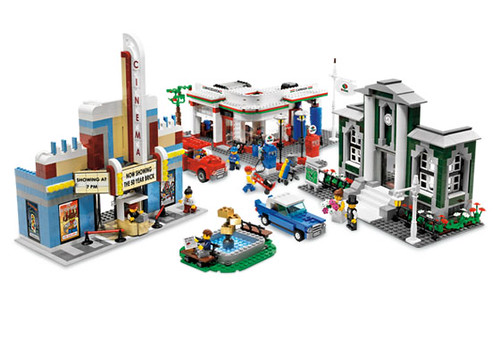
And the update of the 1958 Town Plan set, which Minnie Trackball just got for her birthday:


And this fan built one, which is jaw-dropping gorgeous:


And soon I will post the pictures from Brick Fair 09, which will blow your yellow cylindrical head right off of that peg you call a neck.

The truth about this generation of video game consoles

The truth about this generation of video game consoles (Wii, PS3, Xbox360).

Wii Pros:

  1. Created a new audience of gamers
  2. Did motion control first and best
  3. Made gaming a physical activity
  4. Ingenious games
  5. Cheapest console
Wii Cons:
  1. Relatively high ratio of crappy games, or overpriced motion control demos
  2. Motion plus add-on should have been standard
  3. No other entertainment choices; not used often
  4. Could fade fast: outdated graphics, new gamers won't buy a lot of games or upgrade
  5. Cheapest: limited memory, loud fan noise, disk drive is low quality
  6. Expensive games: lower price tag but many games should be $5 mini-games (Smooth Moves, Wii Sports Resort, Wii Play, etc.)
Truth: Mixed


PS3 Pros:
  1. High cost offset by 1080p HD graphics and super duper computer-like Cell processor
  2. Outstanding games like Little Big Planet, Rag Doll Kung Fu
  3. Is almost a one-stop entertainment hub: , upconverts DVDs, Blu-ray player, extensive library of games, trailers, demos, extra content and movies to download
  4. Motion control gamepad a good mix for a variety of games
  5. Sony diligent about upgrading the software, improving it after purchase
PS3 Cons:
  1. Later start and expensive hardware caused lowest sales
  2. No Netflix access, despite web browser
  3. Limited multiplayer interaction: Playstation Home has been a laughingstock
Truth: amazing, may be Tesla Roadster of consoles, ahead of its time and equal to or better than the next gen Wii and Xbox, especially if Sony keeps tweaking and upgrading software.

Xbox 360 Pros:
  1. Out first, built a big lead
  2. Innovative trophy system and other multiplayer features
  3. Has Netflix (although this is no better than a $100 Roku box because of graphics limitations)
Xbox 360 Cons:
  1. Rushed/sloppy - extremely high hardware failure rate, even in later models
  2. Only 720p, no Blu-Ray (adds about $300 to cost to buy a Blu-ray player and still doesn't equal features of a PS3)
  3. Best games are ports from PC franchises, which are cheaper (COD, GTA)
  4. Backed HD-DVD, and only as an add-on
  5. Poor design: console looks squashed, Xbox controller not made for human hands
Truth: A failure in slow motion. Microsoft is not a hardware company

Deconstructing Batman, Hon

On the eve of the release of Batman: Arkham Asylum, which could very well be the best Batman game ever, and possibly the 2009 Game of the Year, I feel the urge to pontificate on the dark knight.

Batman has had his hokey periods, but with the Chris Nolan-Christian Bale reboot and the animated Batman series of recent years, the Dark Knight has improved greatly. (Batman: The Brave and the Bold series is a turn to the hokey, which is fine for my 6 year old, but Batman may as well fight dragons too, which he kind of does in that cartoon.)

But even the Chris Nolan take on Batman is a bit too unrealistic, as awesome as it is. The essence of Batman is that anyone could be him: no super powers, just focus, hard-work and brains. Batman is realistic. Chris Nolan's Batman is a white guy billionaire, fighting white guy villains (psychologists, drug dealers/mobsters, the Joker) because his parents were killed by another white guy. This seemed plausible in the 1930s (John Dillinger, Al Capone, Machine Gun Kelly, etc.) but today it sounds farfetched. (Maybe, if the Joker was the billionaire, or a talk show host.)

Take the billionaire thing first: being a billionaire is a superpower, even if it is a hyperrealistic power. Even Superman needs a job to pay the bills. Lex Luthor and Bruce Wayne don't have to do squat. Bruce Wayne could just bulldoze whatever neighborhoods he thought were crime ridden.

Next, his motivation rings false: a child orphaned like Bruce Wayne would probably be wrapped in a blanket of therapy, treatment, sycophants, and doing something else with one's life. Do you know how much trauma rich kids are subject to, but don't put on a cape and cowl? Look at the Kennedy's or kids of music or film stars. Why didn't Carrie Fisher become BatGirl and beat up men who cheated on their wives? But becoming obsessed with criminals and crime is just a bit odd. We accept it with Batman because it is the origin story and has been retold so often, but it makes little sense.

Batman seems a bit picky about the crime he wars on. Bruce Wayne lives in a mansion outside the city; when he's in the city he's in the swanky parts. Most of the crime does not happen there (unless it's white collar crime, but apparently Bruce Wayne only goes after poorer criminals?) Does he punch out drug users, prostitutes, embezzlers, jaywalkers, undocumented workers, panhandlers, people driving with suspended licenses and corrupt building inspectors? It would be dramatic for Batman to take down a Ken Lay-Bernie Ebbers type or a deadbeat dad. But someone bending contracting regs down at City Hall? No.

Finally, race. One look at Batman and you know he is a 6'2" white guy with blue eyes, fighting urban street crime in parts of town that he has no connection with. Does that sound likely? Would he be well received by the Black, Asian and Hispanic residents? Put it another way, what if he were a partially disguised Black man fighting crime in Oslo, Norway? He may be easy to track down, is all I'm saying. And it would be a bit odd, don't you think?

A modern Batman ought to be:

  • Black and/or Hispanic
  • Fighting crime he grew up around
  • Have limited resources
  • Only fight certain crimes, and for a particular reason (possibly morally-compromised)
  • Less like the Punisher, more like a ninja Sherlock Holmes
  • Built less like a linebacker and have more martial arts and stealth skills
  • Based in Baltimore, which has Gotham-like problems, but its buildings are relatively low and it is kinda weird, so Batman would fit in.

I've stopped drinking

Sugary drinks, that is. Not alcohol, although on the cruise I did have a sip of both rum (while on a pirate ship) and champagne (on a cruise ship) because you're supposed to try things at times like that. And didn't like either: they are bitter, like grapefruit, which reminds me of vomit-inducing medicines people give kids to convince them to swallow the pill form instead. Escargot: thumbs up. Alcoholey drinks: yecch.

As part of my contribution to the health care reform, much like the discounts that drug companies and health insurance companies promising to create billions of savings, I have given up drinking sugary drinks. Sugary drinks are supposed to be very bad for health, adding empty calories, inducing too much eating, bad for teeth, etc.

Of course, like the drug and health insurance industry, there's no way for the President to hold me to this, but really, I'm doing it more for me than for the country.

Let's review the various parts of the beverage industry that I will be personally ruining and causing job losses in:

Lemonade
Pineapple juice
Orange juice
Orange soda
Sprite
Sarsaparilla
Root beer

With spiraling health care costs, either the cookies or the sugary drinks had to go. Note that I've already dropped almost all high fructose corn syrup, so these are actual sugary drinks (except Sprite). Anything put up against a good cookie will lose. Tasty, tasty, tasty. The drinks will be missed, but all is not lost.

I've found something that is a pretty neat substitute. When you take the sugary drinks, like orange juice, out of your taste palate, the natural sugar of fruits and veggies stands up and drills your sweet tooth. Say hello to my little sugary friends:

Sweet potato
Red peppers
Grapes
Pineapple
Raisins
Cantaloupe
Pumpkin
Watermelon

Next target: french fries

Things I found out on my summer vacation

I can survive several days without internet access: Twitter, email, Facebook, news sites, etc. I cannot survive several days without being able to read and do some writing.

I prefer waffles, especially Belgium waffles, to pancakes. Pancakes are hard to cook well: waffles are hard to screw up.

I bought nothing at the Lego Store, mostly because luggage space was tight. But I spent a crapload of money at the House of Blues store. This was unexpected.

I can eat eggs now. Scrambled eggs, omelets, egg pastries. No allergic reaction.

San Miguel in Cozumel, Mexico was exactly as I expected thanks to popular culture depictions of Mexico, from the buildings to the people, etc. The kicker was that I totally got the Mexican vibe.

Key West was what I expected, at least the western half. Not impressed. Sunburns and beer bottles and misogynistic t-shirts. Cool pirate museum and butterfly exhibits though.

Grand Cayman: I didn't see enough of to have an impression. I spent almost the whole time on a pirate ship and did walk the plank.

I need a swimshirt with long sleeves. The forearms took multiple coats of sunscreen and still got roasty.

Homo sapiens are splitting into two species: homo sapiens and homo sumo. I know and admire plenty of overweight and obese homo sapiens. But they are not homo sumo. I'm not making judgements here, just observing that it seems like we've hit a fork in the evolutionary road, because even the children of homo sumos look different. Maybe having seen Wall-E before going on the cruise had something to do with this thought.

Older kids are much easier to vacation with. We discovered a whole ton of stuff about the Disney Cruise that we didn't know about simply because our kids are older (spa and fitness center, etc.).

I think I met the actual Jack Sparrow and Peter Pan, not people playing them who were very much in character. The scary thing is that I think they each believed this more fervently than I did. Still, Disney characters are the best, even when it is in the 90s outside and hardly any one is looking.

The kids had a blast, and that was as enjoyable as any enjoyment I got out of it personally.

My better half is an amazing operations/logistics research talent. Having your wardrobe planned out by spreadsheet, and getting $54 flights to Orlando are two ways that she made everything go very smoothly.

I would SO go on a DC Comics-themed cruise.

Coming home on a Saturday afternoon is much better than at night, or any time on Sunday.

Our gold fish may very well be immortal.

Disney Cruise Line can and should continue to milk the pirate angle for all it is worth: they have cruise ships, their own Caribbean island, and they own the Pirates of the Caribbean franchise. Aye, they even have the Flying Dutchman anchored at the island. The only way to make it better would be to board and capture some of those ugly Carnival cruise ships: floating casinos on the Spanish Main? Savvy?

Forty years down the drain

Today is the 40th anniversary of the moon landing. I have a great love for space exploration and for history. It truly was a remarkable achievement.

But it was 40 years ago. Two other big technological feats occurred in 1969: ARPANET, predecessor to the internet, got its first link and the Boeing 747 debuted. Both have had huge effects on American society. Will they be celebrated with as much pomp? No. Why? Because they were not the high water mark of network computing or aviation. The internet and a ton of other planes superceded these earlier iterations, and they don't have much hold on us.

We are about to take our brand new space station and destroy it because we don't know what to do with it and it is pricey. Very shortly we will have no space vehicle to launch people into space. This makes me reluctant to whoop it up over a 40 year old achievement that simply reinforces the embarrassment we have felt ever since. It's just sad.

Science fictional economics

How can SF do well in movies, games and TV while getting crushed in the written arena? This has a lot of SF fans scratching their heads. To some extent, this is talking about similar but different products (movies versus books) that have different audiences.

Guys don't read as much as they used to. From kindergarten to college, a big chunk of the male population just dreads reading for whatever reason. No one quite knows why. SF is a male-heavy literary genre. It thrives in video games, movies and other more visual media.

Romance and fantasy, on the other hand, are the opposite. They are booming and have a heavily female following. Women read. Outside of Titanic, there are few mega-blockbuster romance movies.

So what is SF to do? Will it finally break out of its moat of maleness and embrace female readers?

Should it pull in more romance, more heartbreaking vampires, less explosions and Chuck Norris type characters?

Will it try to attract male readers back with ever more male-focused material like battles, alien worlds, hard science, etc.? Or maybe it will shift to the graphic novel arena; less words, more visuals.

Will it sink for decades, like comics did? Is this the end of the silver age then, and are we waiting for the SF Watchmen and Sandman or the 1989 Batman to blow off the cobwebs? Look at what JJ Abrams did with Star Trek: rebooted it in a way that made it better than the original while making it seem more real than the original.

Maybe SF has found its natural home in the blockbuster movie world, and its run in the literary realm is ending. Hell of a time to write a sci-fi novel, huh? And not even have it close to ready for submitting to agents. Argh.

Not thrilled with the king of crotch-grab

So, for all 0.5 of you following this blog, I'm know you are just dying to know what I think about Michael Jackson and his death. As for anyone, I'm sorry to hear that he died when he had so much more planned to do.

As for my opinion of him as a performer, I was never a fan. I remember in 4th grade being the only kid who didn't think that the Thriller album was any good. The Thriller video was even more underwhelming: I heard how scary it was and it looked like a cheesy horror film put to a pop song. I thought Jackson was pretentious, showy and found his voice irritating. The only song I ever warmed to was "Man in the Mirror" and if someone remade it without his voice, it would be 1,000 times better.

Now that he died of what was likely a drug overdose, we can see his whole catalog and his effect on pop culture. And it amounts to: meh. He was a star of the 70s and 80s, huge for a time, like Pac-Man and Different Strokes. But he left the scene by the late 80s, eclipsed by his own sister on the current music scene by the early 90s.

Always lurking was the freak show. He was a rolling freak show of freak shows, with the chimp, the plastic surgery, the hyperbaric sleeping chamber, marrying Lisa Marie Presley, Neverland, the first child molestation charges, his second marriage, dangling his child over a balcony, the second child molestation charges and so on. And let's not forget what started the freak show: the crotch-grabbing. Ah yes, the non-sexual but not asexual crotch grab that made one think that an emaciated banana republic dictator with a Liberace streak really needed some jock itch cream.

Here are some of the music artists from the same era who have had a longer lasting effect, a greater effect on pop culture and had longer careers than Michael Jackson:
Elton John
Madonna
Billy Joel
Rod Stewart
Led Zeppelin
Bruce Springsteen
John Mellencamp
U2
Tony Bennett
Aerosmith
The Rolling Stones
Paul McCartney

Their music will outlive them. All anyone will remember about him is the molestation charges/trials, etc. When was the last time any Gen Xer fans of him even bothered to listen to his stuff? His crap doesn't even reach the level of Patrick Swayze's "She's like the wind" on 80s radio stations.

I know, you're about to throw all the press attention his death got back in my face. Whoopee, Nixon got good press when he died in 1994. Princess Diana, well, let's not discuss her.