The truth about being a contrarian

The truth about being a contrarian is that it is a tough position to have. Cassandras, futurists, technical experts, etc. are the people who inevitably hold the minority opinion on a topic. They may be sought out to entertain, educate or just as an intellectual freak show. They are often the punching bag that conventional wisdom takes some cheap shots on. But it can wear on the contrarian.

Yes, I have been a contrarian my whole life and it's not because I choose to be, but because I think differently. Sometimes I come off as a contrarian just because I give voice to an angle of an issue that has been woefully missed, even if I don't agree with it. In those cases, bringing it up is often to get the angle discussed a bit, shed some light on it, and not to argue that it is right or wrong. Sometimes it is because I just see more angles on a subject, or I can cut through to the heart of an issue rather than be distracted by side issues or minutiae. Contrarianism comes in many flavors.

My contrarian opinions are not always right, thank the Flying Spaghetti Monster, and the blues don't come from batting less than twenty percent. The contrarian blues don't happen because the contrarian has the minority opinion and loses a lot. The blues happen to the person who brings a contrarian opinion to bear and no one pays attention to it. They can't get past the velvet rope of conventional thinking/wisdom. Agreeing with the conventional wisdom seems to be the prerequisite for participating in a discussion on many many different subjects.

Ironically, some of you may be assuming that I am subtly referring to work. This is actually not true at all - work seems to be more open to thinking differently than ever before, or maybe I am less contrarian than usual. I am really referring to society at large, from public policy to product design to traffic management, it seems like the barring of contrarianism has become more commonplace.

A near perfect natural experiment in this regard will happen very shortly. The President has called for a jobs summit, because the conventional wisdom, and the politically expedient options, apparently have not worked and unemployment is over 10%. He seems very open to any and all ideas that may work, so the contrarians should be able to at least not be barred or ignored.

Let's see if 1) anyone gets in who has contrarian ideas, and 2) if the media, or the administration, or its critics listens to those ideas. It is perfectly okay to reject them out of hand, the point is to see if these ideas are let into the discussion at all.


Messing up math

This op-ed from the Baltimore Sun elegantly describes my thoughts about how math education has gone awry. It is almost like math is a subject we don't understand, so we teach it in the most oddly incorrect ways.

We teach math, like algebra and trigonometry, which the vast majority of us never use afterward. There's a fine line between having a basic knowledge of a subject and slogging through college level detail on a subject. English, social studies, even the health curriculum seems to hit the right balance.

Conversely, we don't teach students math they could use in their daily life, and which could be mastered at a developmentally-appropriate age. Statistics and money management should replace trig and calculus before college. Mortgages and interest rates instead of sine and cosine.

The way we teach math also drives students away from the subject by making them memorize meaningless rules of advanced techniques. Without understanding the math they learn in middle and high school because it is not developmentally appropriate, students give up on the subject.

Our study shows that what we like to do makes us healthier! Right...

Have I not posted in a month? Good grief. Well, here's something I have been chewing over for a while.

The truth about studies showing the health benefits of alcohol consumption is that they are wishful thinking wrapped in scientific-studies biased in subtle ways.

Here is a recent one: that alcohol consumption can reduce the risk of dementia.

First, be a bit dubious of a study that reviews the results of other studies. It's almost original research, but it's not the same thing as constructing a study to focus on that issue.

Second, be skeptical of studies that bless behavior people want to do anyway. Whether it is simply media spin, subtle bias on the part of the researchers or overt bias, it's pretty dodgy.

Third, be enormously skeptical of any study that can't separate out behavioral aspects that have non-random socio-economic correlations.

For this study, chances are that there are a number of factors related to alcohol consumption and the risk of dementia and Alzheimer's. Those who drink alcohol may be more socially active, which can reduce the risk of dementia. Those in and out of hospitals and nursing homes are less able to drink alcohol compared to healthier people. Moderate wine-drinking professors emeritus may have a much lower risk of dementia than their alcohol-abusing lower educated and lower income cohorts who are more prone to heavy alcohol consumption. Obese elderly likely are not moderate drinkers, and we know obesity has a strong effect on mental functionality.

Conclusion: You can't separate out these factors, so tying alcohol consumption to a lower risk of dementia is likely spurious, at best.

Who knew free-running was for real?

There's two kinds of people in the world: those who like to be chased and those who do the chasing. I mean literally, not in some kind of financial, romantic or metaphysical. I mean driving, running, even walking.

As a young kid, I knew that I liked being chased much more than doing the chasing. All I had to do was stay ahead of the pursuer, and I sort of controlled where the chase went. I would use my big mouth to get other kids to chase me on the school playground. I rarely got caught.

I wasn't especially fast. It was because I would take unconventional paths, racing full speed toward obstacles like tree roots, other kids, playground equipment, etc. The other kids would have to slow down and still would trip, stumble and backtrack, allowing me to get away.

How did I do it? Somehow, I was able to observe, plan and execute a route through the obstacles long before I physically reached them. I could see the route through a tight spot before I come to it, planned where to put my lead foot, how to twist my torso, and so on. I had to solve this puzzle continually and it was great fun to get that rush as I was able to do it, all while keeping the pursuers at arms length.

To do this, I had to cut certain things close: twisting and turning to fit through small gaps, avoid tree branches or jungle gym bars, running on ice. This skill greatly helped in my brief but legendary career in the difficult world of elementary school dodgeball.

Doing this produced a certain amount of grace in movement, from the constant motion, the minimal exertion to avoid obstacles combined with a constant speed. It creates a kind of high, flowing across the ground, mind moving faster than my feet.

This, I found out recently, thanks to Paul Blart: Mall Cop, is a sport called free running, or parkour in France. These two physical disciplines are very close to what I did as a kid. That is pretty awesome. Watching free running is nearly as much fun as doing it, I bet.

Now that I'm living here in the future, where's my free running HD channel?

Toy Story Legos mentioned in story about Lego toys

Yes, when Toy Story 3 comes out next summer, there will be a new line of Lego sets for it. They will join SpongeBob, Indiana Jones, Batman, Star Wars and other themed Lego product lines. Pretty much you put a cool media thing in front of Lego, and I start to salivate.

K/2 to NYT for breaking this particular toy story. For those of you Lego fans, whether you are an Adult Fan Of Lego (AFOL) or searching for bricks for your kids, the NYT has a big feature piece on the company and its bricky goodness.

(What is k/2? It's short for 'kudos to' my improvement on the h/t moniker, which I think is not useful and to quote Inigo Montoya: I do not think it means what you think it means. Princess Bride Legos? That would so rock.)

It's a hoot that they found someone who dislikes the company's resurgence and all-around success, because Lego is deep into movie and TV-themed product lines. Substitutes Hollywood's imagination for open-ended play of old-fashioned Legos, they claim. Someone ought to tell them that the sets come apart and can be built into whatever you want.

You want creative? How about the new Fire Brigade set:


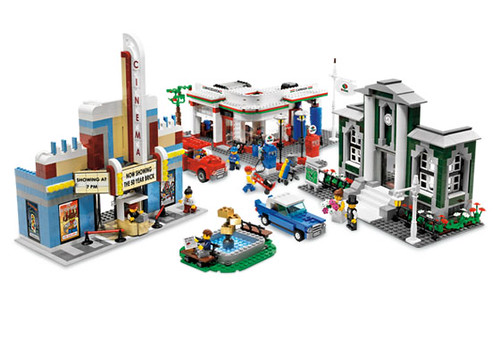
And the update of the 1958 Town Plan set, which Minnie Trackball just got for her birthday:


And this fan built one, which is jaw-dropping gorgeous:


And soon I will post the pictures from Brick Fair 09, which will blow your yellow cylindrical head right off of that peg you call a neck.

The truth about this generation of video game consoles

The truth about this generation of video game consoles (Wii, PS3, Xbox360).

Wii Pros:

  1. Created a new audience of gamers
  2. Did motion control first and best
  3. Made gaming a physical activity
  4. Ingenious games
  5. Cheapest console
Wii Cons:
  1. Relatively high ratio of crappy games, or overpriced motion control demos
  2. Motion plus add-on should have been standard
  3. No other entertainment choices; not used often
  4. Could fade fast: outdated graphics, new gamers won't buy a lot of games or upgrade
  5. Cheapest: limited memory, loud fan noise, disk drive is low quality
  6. Expensive games: lower price tag but many games should be $5 mini-games (Smooth Moves, Wii Sports Resort, Wii Play, etc.)
Truth: Mixed


PS3 Pros:
  1. High cost offset by 1080p HD graphics and super duper computer-like Cell processor
  2. Outstanding games like Little Big Planet, Rag Doll Kung Fu
  3. Is almost a one-stop entertainment hub: , upconverts DVDs, Blu-ray player, extensive library of games, trailers, demos, extra content and movies to download
  4. Motion control gamepad a good mix for a variety of games
  5. Sony diligent about upgrading the software, improving it after purchase
PS3 Cons:
  1. Later start and expensive hardware caused lowest sales
  2. No Netflix access, despite web browser
  3. Limited multiplayer interaction: Playstation Home has been a laughingstock
Truth: amazing, may be Tesla Roadster of consoles, ahead of its time and equal to or better than the next gen Wii and Xbox, especially if Sony keeps tweaking and upgrading software.

Xbox 360 Pros:
  1. Out first, built a big lead
  2. Innovative trophy system and other multiplayer features
  3. Has Netflix (although this is no better than a $100 Roku box because of graphics limitations)
Xbox 360 Cons:
  1. Rushed/sloppy - extremely high hardware failure rate, even in later models
  2. Only 720p, no Blu-Ray (adds about $300 to cost to buy a Blu-ray player and still doesn't equal features of a PS3)
  3. Best games are ports from PC franchises, which are cheaper (COD, GTA)
  4. Backed HD-DVD, and only as an add-on
  5. Poor design: console looks squashed, Xbox controller not made for human hands
Truth: A failure in slow motion. Microsoft is not a hardware company

Deconstructing Batman, Hon

On the eve of the release of Batman: Arkham Asylum, which could very well be the best Batman game ever, and possibly the 2009 Game of the Year, I feel the urge to pontificate on the dark knight.

Batman has had his hokey periods, but with the Chris Nolan-Christian Bale reboot and the animated Batman series of recent years, the Dark Knight has improved greatly. (Batman: The Brave and the Bold series is a turn to the hokey, which is fine for my 6 year old, but Batman may as well fight dragons too, which he kind of does in that cartoon.)

But even the Chris Nolan take on Batman is a bit too unrealistic, as awesome as it is. The essence of Batman is that anyone could be him: no super powers, just focus, hard-work and brains. Batman is realistic. Chris Nolan's Batman is a white guy billionaire, fighting white guy villains (psychologists, drug dealers/mobsters, the Joker) because his parents were killed by another white guy. This seemed plausible in the 1930s (John Dillinger, Al Capone, Machine Gun Kelly, etc.) but today it sounds farfetched. (Maybe, if the Joker was the billionaire, or a talk show host.)

Take the billionaire thing first: being a billionaire is a superpower, even if it is a hyperrealistic power. Even Superman needs a job to pay the bills. Lex Luthor and Bruce Wayne don't have to do squat. Bruce Wayne could just bulldoze whatever neighborhoods he thought were crime ridden.

Next, his motivation rings false: a child orphaned like Bruce Wayne would probably be wrapped in a blanket of therapy, treatment, sycophants, and doing something else with one's life. Do you know how much trauma rich kids are subject to, but don't put on a cape and cowl? Look at the Kennedy's or kids of music or film stars. Why didn't Carrie Fisher become BatGirl and beat up men who cheated on their wives? But becoming obsessed with criminals and crime is just a bit odd. We accept it with Batman because it is the origin story and has been retold so often, but it makes little sense.

Batman seems a bit picky about the crime he wars on. Bruce Wayne lives in a mansion outside the city; when he's in the city he's in the swanky parts. Most of the crime does not happen there (unless it's white collar crime, but apparently Bruce Wayne only goes after poorer criminals?) Does he punch out drug users, prostitutes, embezzlers, jaywalkers, undocumented workers, panhandlers, people driving with suspended licenses and corrupt building inspectors? It would be dramatic for Batman to take down a Ken Lay-Bernie Ebbers type or a deadbeat dad. But someone bending contracting regs down at City Hall? No.

Finally, race. One look at Batman and you know he is a 6'2" white guy with blue eyes, fighting urban street crime in parts of town that he has no connection with. Does that sound likely? Would he be well received by the Black, Asian and Hispanic residents? Put it another way, what if he were a partially disguised Black man fighting crime in Oslo, Norway? He may be easy to track down, is all I'm saying. And it would be a bit odd, don't you think?

A modern Batman ought to be:

  • Black and/or Hispanic
  • Fighting crime he grew up around
  • Have limited resources
  • Only fight certain crimes, and for a particular reason (possibly morally-compromised)
  • Less like the Punisher, more like a ninja Sherlock Holmes
  • Built less like a linebacker and have more martial arts and stealth skills
  • Based in Baltimore, which has Gotham-like problems, but its buildings are relatively low and it is kinda weird, so Batman would fit in.

I've stopped drinking

Sugary drinks, that is. Not alcohol, although on the cruise I did have a sip of both rum (while on a pirate ship) and champagne (on a cruise ship) because you're supposed to try things at times like that. And didn't like either: they are bitter, like grapefruit, which reminds me of vomit-inducing medicines people give kids to convince them to swallow the pill form instead. Escargot: thumbs up. Alcoholey drinks: yecch.

As part of my contribution to the health care reform, much like the discounts that drug companies and health insurance companies promising to create billions of savings, I have given up drinking sugary drinks. Sugary drinks are supposed to be very bad for health, adding empty calories, inducing too much eating, bad for teeth, etc.

Of course, like the drug and health insurance industry, there's no way for the President to hold me to this, but really, I'm doing it more for me than for the country.

Let's review the various parts of the beverage industry that I will be personally ruining and causing job losses in:

Lemonade
Pineapple juice
Orange juice
Orange soda
Sprite
Sarsaparilla
Root beer

With spiraling health care costs, either the cookies or the sugary drinks had to go. Note that I've already dropped almost all high fructose corn syrup, so these are actual sugary drinks (except Sprite). Anything put up against a good cookie will lose. Tasty, tasty, tasty. The drinks will be missed, but all is not lost.

I've found something that is a pretty neat substitute. When you take the sugary drinks, like orange juice, out of your taste palate, the natural sugar of fruits and veggies stands up and drills your sweet tooth. Say hello to my little sugary friends:

Sweet potato
Red peppers
Grapes
Pineapple
Raisins
Cantaloupe
Pumpkin
Watermelon

Next target: french fries

Things I found out on my summer vacation

I can survive several days without internet access: Twitter, email, Facebook, news sites, etc. I cannot survive several days without being able to read and do some writing.

I prefer waffles, especially Belgium waffles, to pancakes. Pancakes are hard to cook well: waffles are hard to screw up.

I bought nothing at the Lego Store, mostly because luggage space was tight. But I spent a crapload of money at the House of Blues store. This was unexpected.

I can eat eggs now. Scrambled eggs, omelets, egg pastries. No allergic reaction.

San Miguel in Cozumel, Mexico was exactly as I expected thanks to popular culture depictions of Mexico, from the buildings to the people, etc. The kicker was that I totally got the Mexican vibe.

Key West was what I expected, at least the western half. Not impressed. Sunburns and beer bottles and misogynistic t-shirts. Cool pirate museum and butterfly exhibits though.

Grand Cayman: I didn't see enough of to have an impression. I spent almost the whole time on a pirate ship and did walk the plank.

I need a swimshirt with long sleeves. The forearms took multiple coats of sunscreen and still got roasty.

Homo sapiens are splitting into two species: homo sapiens and homo sumo. I know and admire plenty of overweight and obese homo sapiens. But they are not homo sumo. I'm not making judgements here, just observing that it seems like we've hit a fork in the evolutionary road, because even the children of homo sumos look different. Maybe having seen Wall-E before going on the cruise had something to do with this thought.

Older kids are much easier to vacation with. We discovered a whole ton of stuff about the Disney Cruise that we didn't know about simply because our kids are older (spa and fitness center, etc.).

I think I met the actual Jack Sparrow and Peter Pan, not people playing them who were very much in character. The scary thing is that I think they each believed this more fervently than I did. Still, Disney characters are the best, even when it is in the 90s outside and hardly any one is looking.

The kids had a blast, and that was as enjoyable as any enjoyment I got out of it personally.

My better half is an amazing operations/logistics research talent. Having your wardrobe planned out by spreadsheet, and getting $54 flights to Orlando are two ways that she made everything go very smoothly.

I would SO go on a DC Comics-themed cruise.

Coming home on a Saturday afternoon is much better than at night, or any time on Sunday.

Our gold fish may very well be immortal.

Disney Cruise Line can and should continue to milk the pirate angle for all it is worth: they have cruise ships, their own Caribbean island, and they own the Pirates of the Caribbean franchise. Aye, they even have the Flying Dutchman anchored at the island. The only way to make it better would be to board and capture some of those ugly Carnival cruise ships: floating casinos on the Spanish Main? Savvy?

Forty years down the drain

Today is the 40th anniversary of the moon landing. I have a great love for space exploration and for history. It truly was a remarkable achievement.

But it was 40 years ago. Two other big technological feats occurred in 1969: ARPANET, predecessor to the internet, got its first link and the Boeing 747 debuted. Both have had huge effects on American society. Will they be celebrated with as much pomp? No. Why? Because they were not the high water mark of network computing or aviation. The internet and a ton of other planes superceded these earlier iterations, and they don't have much hold on us.

We are about to take our brand new space station and destroy it because we don't know what to do with it and it is pricey. Very shortly we will have no space vehicle to launch people into space. This makes me reluctant to whoop it up over a 40 year old achievement that simply reinforces the embarrassment we have felt ever since. It's just sad.

Science fictional economics

How can SF do well in movies, games and TV while getting crushed in the written arena? This has a lot of SF fans scratching their heads. To some extent, this is talking about similar but different products (movies versus books) that have different audiences.

Guys don't read as much as they used to. From kindergarten to college, a big chunk of the male population just dreads reading for whatever reason. No one quite knows why. SF is a male-heavy literary genre. It thrives in video games, movies and other more visual media.

Romance and fantasy, on the other hand, are the opposite. They are booming and have a heavily female following. Women read. Outside of Titanic, there are few mega-blockbuster romance movies.

So what is SF to do? Will it finally break out of its moat of maleness and embrace female readers?

Should it pull in more romance, more heartbreaking vampires, less explosions and Chuck Norris type characters?

Will it try to attract male readers back with ever more male-focused material like battles, alien worlds, hard science, etc.? Or maybe it will shift to the graphic novel arena; less words, more visuals.

Will it sink for decades, like comics did? Is this the end of the silver age then, and are we waiting for the SF Watchmen and Sandman or the 1989 Batman to blow off the cobwebs? Look at what JJ Abrams did with Star Trek: rebooted it in a way that made it better than the original while making it seem more real than the original.

Maybe SF has found its natural home in the blockbuster movie world, and its run in the literary realm is ending. Hell of a time to write a sci-fi novel, huh? And not even have it close to ready for submitting to agents. Argh.

Not thrilled with the king of crotch-grab

So, for all 0.5 of you following this blog, I'm know you are just dying to know what I think about Michael Jackson and his death. As for anyone, I'm sorry to hear that he died when he had so much more planned to do.

As for my opinion of him as a performer, I was never a fan. I remember in 4th grade being the only kid who didn't think that the Thriller album was any good. The Thriller video was even more underwhelming: I heard how scary it was and it looked like a cheesy horror film put to a pop song. I thought Jackson was pretentious, showy and found his voice irritating. The only song I ever warmed to was "Man in the Mirror" and if someone remade it without his voice, it would be 1,000 times better.

Now that he died of what was likely a drug overdose, we can see his whole catalog and his effect on pop culture. And it amounts to: meh. He was a star of the 70s and 80s, huge for a time, like Pac-Man and Different Strokes. But he left the scene by the late 80s, eclipsed by his own sister on the current music scene by the early 90s.

Always lurking was the freak show. He was a rolling freak show of freak shows, with the chimp, the plastic surgery, the hyperbaric sleeping chamber, marrying Lisa Marie Presley, Neverland, the first child molestation charges, his second marriage, dangling his child over a balcony, the second child molestation charges and so on. And let's not forget what started the freak show: the crotch-grabbing. Ah yes, the non-sexual but not asexual crotch grab that made one think that an emaciated banana republic dictator with a Liberace streak really needed some jock itch cream.

Here are some of the music artists from the same era who have had a longer lasting effect, a greater effect on pop culture and had longer careers than Michael Jackson:
Elton John
Madonna
Billy Joel
Rod Stewart
Led Zeppelin
Bruce Springsteen
John Mellencamp
U2
Tony Bennett
Aerosmith
The Rolling Stones
Paul McCartney

Their music will outlive them. All anyone will remember about him is the molestation charges/trials, etc. When was the last time any Gen Xer fans of him even bothered to listen to his stuff? His crap doesn't even reach the level of Patrick Swayze's "She's like the wind" on 80s radio stations.

I know, you're about to throw all the press attention his death got back in my face. Whoopee, Nixon got good press when he died in 1994. Princess Diana, well, let's not discuss her.

Thinking about Ps & Qs: Pitches and Queries

In the previous post I mentioned that I attended a panel on how to pitch your project to agents, editors, etc. Here are the highlights (almost a month late):

Neal Levin, publisher: He admitted that it's hard for writers to reach him when he gets about 250 queries a month. And he had three book pitches at Balticon that day, including one he implied came from the author sitting next to me, James Daniel Ross.

Nancy Greene, author: She related many of the ups and downs of querying and if I remember correctly, she stressed tailoring queries to agents with different interests and likes/dislikes.

David J. Williams, author: Had a lot of great tips, which he noted can be found here. Namely, avoid the query letter meatgrinder if possible and try to talk to agents face to face if you don't know anyone in the biz. He has a copy of the query letter that worked for him. It's about 90% describing the story, 10% credentials and 0% wasted words.

Jonathon Mayberry, author: has taught classes in how to query and had the most to say. He mentioned a Maberry formula that goes as such:
1. Name protagonist and crisis
2. Appeals to readers of...
3. Credentials

His site with a sample query letter and other advice and tips is here.

Lessons from authors at Balticon 43

Outside of my Balticon panel coverage in the previous post, I had a couple of interactions with authors that led me to important insights.

Charles Stross was the Guest of Honor (GoH) and I both talked with him and went to his Q&A. I also follow his blog quite closely and this is an amalgamation of all of things he has said in all of these venues that were either directed at me or could have been had I been standing in front of him, annoying him as he spoke or wrote them.

For some reason, when he discusses writing, he breaks it down in a way that makes the process sound unmysterious and so damn feasible. See his post at Tor.com about how he gets ideas stresses how easy it is if you are naturally curious and not working too hard at it. The submarine bit in The Jennifer Morgue he got from a real-life documentary about just such a thing. His rules for stealing ideas is to steal from the best and make sure they are clearly dead (but do not murder them).

He writes SF for geeks who he thinks didn't have an author writing for them. SF has been dominated by speed and power, he says, rocket engineers and frontier types. It's nearly a mature art, though and he seemed to hint that it's time may have passed, or at least the common tropes need to get replaced. His latest novel, Saturn's Children, pretty much screams that SF needs to reorient to something more meaningful and timely than interplanetary work commutes, aliens, time travel and terraforming.

His Laundry novels he just has so much fun writing and it makes it easier for him and more enjoyable. Another point in the 'do what you love' column.

He is a real geek, much more so than I. He's a fiction geek almost like Spielberg is a film geek. Something for me to aspire to.

I got an inkling that social science fiction may not be for the real geek crowd. Charlie (can I call you that, Mr. Stross?) and I had a short debate over whether increasing social complexity is a good thing or not, that I think I need to continue further, if he'll indulge me. But that aside, if no one in the shrinking sci-fi world even gets much social science, or has much interest, then my stuff is not headed toward the right place.

Stephanie Draven is a friend of mine from high school days, who probably associates with me against her better judgment given all that she and her sister know about me from back in the day. She is a recently published author with an agent, and a book deal and deadlines and contracts. Things that I learned or knew but she reinforced in my head include:

SF literature is having a hard time while romance and fantasy are doing well, in an industry that overall is doing badly. Escapist fiction seems to be doing very well, even while science fiction does well at the box office and on TV. People are drawn to fantasy for some reason in print, especially if there be vampires or bodice-ripping. Meanwhile, rivets, outer space, aliens and lasers work well visually: go figure.

Dumb down my pitches. Way down. I made a pitch that referenced Tom Friedman's pop social science classic about globalization: The Lexus and the Olive Tree. No one at the writer's workshop expressed any recognition of it. I tried other pitches out that mentioned Malcolm Gladwell's books and others. She kept shaking her head patiently, motioning to bring it down more. I stopped before I got to Captain Underpants. Apparently, it's not too hard to go above the heads of publishing acquisition folks and the marketing department.

She also boosted my confidence that Scrivener is the way to go for a writing project software. I bought it shortly afterwards, which I had been planning on doing, but did so with gusto, folks.

Balticon 43 Report

Things I learned at Balticon 43: (yes, it's not done yet, but still)

Hard science for beginners: Dr. Cmar, a friend of mine, was on a panel with three physicist types and they fielded audience questions. I was hoping it would be a good old 'hard' vs. 'soft' science battle, but it was more of really well informed physics geeks trying to stump older physicist geeks about MHDs, string theory, dark matter, etc. I'm below the level of a physics beginner, and it was only interesting to find out some interesting sources for beginners. And poor Cmar only got to mention syphilis once or twice.

Writer's Workshop:
I was the only sci-fi writer in the room; everyone else is or has been focused on fantasy.
My one line Hollywood pitch failed miserably in part because of point #1. I referenced a New York Times Bestseller that no one had heard of. More about that later.

Pitch panel:
Excellent. Jonathon Maberry has taught how to pitch projects, the moderator actually moderated, Neal Levin is a publisher who gave his perspective. How to pitch a project in a business sense is different than the artistic argument and how to handle subgenre, buzzwords, structure the query letter, etc. were very insightful.

AI panel:
Mostly a review of how it has been used in sci-fi (robot, computer, augment) and a little about how close to real-life it could get. It was okay.

Psychohistory Update:
Nathan Bos from Applied Physics Lab wowed me not with the mind control and ESP stuff, but with the predicting the future stuff. Unfortunately it was towards the end and we only got a bit into the prediction markets and stuff before I had to bail. I may have to link up with him professionally as we may have social science modeling interests in common.

Games2U Truck: massive amounts of awesome, especially for my 6 yr old clone, who was tired and cranky when we approached it. He ended up having about an hour of fun playing Kung Fu Panda on an Xbox 360.

The conversations I had about writing with writers I'll get into in another post.

So what are you?

The newest survey on Americans' religious preferences is out. Guess what? People who have no organized religion are still a growing proportion, and the percent of atheist/agnostic is up to 12%, 34% in Vermont. Catholics are shifting from the Northeast to the Southwest, probably because of immigration in the Southwest more than anything going on in the Northeast. ABC has a summary of the findings, but please ignore their asinine 'informal survey on Twitter.'

At the very least, the country is becoming much more pluralistic when it comes to religion, and that is a good thing. When a dominating majority of Americans were one flavor of Christian or another, everyone assumed everyone was. Now, it's harder to tell. People have to ask: what are you?

But even that question sounds a bit creaky and outdated. One phenomenon that has grown is Americans changing their religious affiliation. What are you implies that your religious ID is permanent and fixed. What do you believe? Or What do you call yourself? May be more apt.

And finally, lets deal with the 'nones,' the 'seculars,' the atheist/agnostic/unsure catchall. Atheist is the new gay, as evidenced by the polling data that it has overtaken race as the thing parents don't want to find in their children's significant other. As gay marriage is approved by a new state every other week, atheism has become the new gay. But it may not last very long in that spot.

Somehow, in a hurry, the U.S. is joining Western Europe as a more open, tolerant, polyglot society. It seems to be driven by 'the young people' which our press subtly implies is anyone under age 45.

While waiting for the bus recently, I was talking with a friendly middle-aged, self-identified Jewish woman who is reading Chris Hitchens' book God is not Great. She found the book interesting, and not threatening to her beliefs. I haven't read the book, but read reviews and debates about it, and was able to chat about it a bit. The interesting part is she never asked me: so what are you? That is some real progress.

Cross the streams

I was recently reminded that one area of life can easily feed into another, if you let it. As Egon once said in Ghostbusters, it's time to cross the streams.

Writing a document involves several different tasks: organizing and gathering the information, writing, rewriting, producing the text, making notes, etc. But a word processor can only help with the production of the text. It won't help you collect all of your research so it is in one place, it won't help you format the document, it won't help you re-organize the document as you rewrite it.

At work, I have been using integrated development environments for coding projects, where everything one needs to get the work done is collected in one place. The idea is that you can devote the maximum amount of effort to getting work done instead of switching between windows, trying to find that note you had somewhere, or re-finding that research material you put... somewhere.

So why not apply the efficiency from the programming world to the writing one? Brilliant.

I think I'm leaning toward this creative writing software program for that part of my life. More about finding one for work later.

Word choice

All my life, word choice has mattered to me. I would get confused by imprecise directions, poorly explained ideas or rules, etc. I appreciate the precise language of the law and philosophy which others regard as picky hair-splitting. I adore the well crafted phrase, the muscular verb, the witty Twitter tweet.

There are the words and phrases that are cheese graters on my ears because of the emptiness or the evil intent:
going forward
in order to
the impact of
nonbeliever, nonreligious
sexist and racist epithets

Some folks are mightily upset by profanity, which is taken to be either unspeakably rude, mean-spirited, inarticulate or showing lack of character. A lot of it is scatological, and anything referring to the human body is considered off limits by some. This is a front, as I challenge anyone to be offended by my wife's use of the phrase "bladder of steel" to describe Micro Trackball's limited bathroom-going. Or George W. Bush's nickname for his advisor Karl Rove: "Turd Blossom." May have been a lousy President, but he has some word choice chops.

I find it odd that a shorthand reference to a penis is not objected to and is casually used or has multiple meanings (dork, cock, dong, scumbag, has balls, etc.) while any reference to a vagina (including the word 'vagina') is treated with an awed horror akin to yelling "Voldemort" in the middle of Hogwarts. It is the Organ that Shall Not be Named. People may cringe when someone says you 'throw like a girl,' but call anyone a 'pussy' and there's likely to be a fight. And of course the non-slang, scientific term 'clitoris' makes people pass right the fuck out.

As you can guess, profanity doesn't bother me. When a little kid wearing a backpack angrily calls Hancock an 'asshole' at the beginning of the movie 'Hancock' it nailed my funny bone hard. Why? There is brutal honesty in that, and there's no better way to convey how low public opinion of Hancock has fallen at that point in the story. And I bet that kid loved filming that scene. Profanity is just another toolbox of words that, when used in the right amounts, can do something nothing else can. Some people can be offended by any and everything, so tread carefully.

What about politically correct speech? My rule here is that if a group wants to be called "Native Americans" and object to other labels or monikers, then we should respect that. And they can change their minds whenever they want and we should go with that. After all, if I introduce myself as Trackball, I don't want to be called "Brainless." And if people change their names when they get married, it's stupid and rude to refer to them by their previous names.

So watch your word choice.

The revolution will not be printed

As a professional nonfiction producer, voracious consumer and amateur fiction producer of written communication, I can sense a shift coming in how we communicate with words. Some of this is driven by the death of print journalism (h/t Warren Ellis) as newspapers and magazines and short fiction markets shrink and die. Some of this is prompted by the rise of e-books and DRM-free pdfs given away or sold by authors. Some of this is pushed by online only journalism sites (Engadget, Politico, TMZ come to mind).

Some of this is spurred by how professional written products seem to be more potently condensed than they used to be. I suspect that news articles of the future may look something like this:

End of Hero Films?

  • Aquaman Reboot Tanks
  • Underwater love scene gets laughs
  • Studios turn to lucrative Thai action pics
I'm not sure if I am bothered by this to some extent. In a faster-moving society like ours, we are getting better at time management. The above bullet blurbie thing will suit most people out there who really don't want to know what Aquaman Resurfaces' director thinks about his bomb.

Long-form journalism, nonfiction and fiction are not going anywhere, so don't worry, all of you long-form producers. People still want that kind of writing, but the delivery channels are probably in a phase transition. No one knows how it will shake out, but the journey to that point will probably be pretty interesting.

The truth about Jar Jar Binks

The Phantom Menace came out a decade ago and there are plenty of geeks my age who are still pissed about the very existence of Jar Jar Binks. Yes, the Jamaican-accented clumsy Gungan, who bumbles, fumbles and ultimately is Palpatine's stooge.

The ironic thing is, my 6 year old son considers Jar Jar harmless comic relief. That good ole Jar Jar, talking funny like Yoda, but not serious, even about himself. He's good for a few gags. His appeal to kids is obvious and Lucas' point to some extent. Almost any Cartoon Network series has a buffoon character somewhere and why? Because he makes the other characters and the audience feel more competent. And 30-something geeks who had hoped to relive their childhoods at a Star Wars movie need to get a grip. You dug the Ewoks and Jawas, right? At least the Gungans managed to build beautiful cities, rather than treehouses and rolling lunch boxes.

The truth is that JJ Binks moves the plot along and is visually interesting. It's funny that he is an outcast among his own people. He gives the Queen the idea for allying with the Gungans by showing how even goofy morons can be of aid sometimes, like when they are taken seriously. And he manages to help defeat the droid army at the end of Phantom.

But he is not the most annoying and useless character in the Star Wars movies. No, that honor belongs to... you guessed it... C-3PO. Yes, I loved him too as a character, but he was completely useless and a gaping plot hole. Why didn't Artoo have a vocalizer? Rockets in his legs, holographic projector, computer interface and a blue shocky thing, but can't vocalize Basic? If Artoo could speak, there would be no need for Threepio. A protocol droid? Built by Anakin? Why didn't Anakin build Artoo? Artoo, like the Jawas and Ewoks, appealed to kids. Threepio appealed to no one.

And he's a prissy worrywart English butler, as Lucas intended. Not a cool English butler, like Batman's Alfred Pennyworth. Did you notice that everyone in Star Wars with an English accent is an Imperial? Except Threepio. Maybe if Threepio turned out to be an Imperial spy and went HAL on the Millenium Falcon and Han Solo, that would have justified his existence. Maybe if there was some reason he had to store the Death Star plans. But no, he's just an idiot slowing everyone else down.

There were only three good moments with Threepio: when he was shot to pieces in Cloud City, when Jabba backhanded him, and when Salacious Crumb pulled his photoreceptor (eye) out. The outraged/scared/worried Threepio gag got old by, uh, let's see, the Sand People attack on Luke in New Hope. When he advises Luke and Ben to leave him behind, they should have looked at each other, shrugged, and pitched his goldbricking ass down another sand dune. Hell, Luke tried to give him away in Jedi (you knew he wasn't really giving away Artoo because he had Luke's lightsaber), and I don't recall Leia mentioning him in her holographic message. Shit, even Artoo seemed surprised to see Threepio again on Jabba's sail barge, and you know he was thinking, "What the hell is wrong with Jabba? The old Jabba would have melted down this pain in ass to make a doorknob or something. Can't trust anyone any more."

Finally, the Clone Wars cartoon series recently had an episode "Bombad Jedi" that paired C-3PO with Jar Jar. And guess what, C-3PO is a nattering moron, and Jar Jar, by comparison, looks like an action hero.